Rule card
How to play the kubb yard game
Kubb is a Swedish yard game played with wooden blocks and throwing batons: knock over the other team's kubbs, then topple the king before they topple yours. It takes five minutes to learn and a whole summer to get good at.
On this card
- Setting up the field
- Throwing the batons
- Throwing the field kubbs back
- Going for the king
- A short history of the Viking game
- Teams, kids and big groups
- Tips and care
Setting up the field
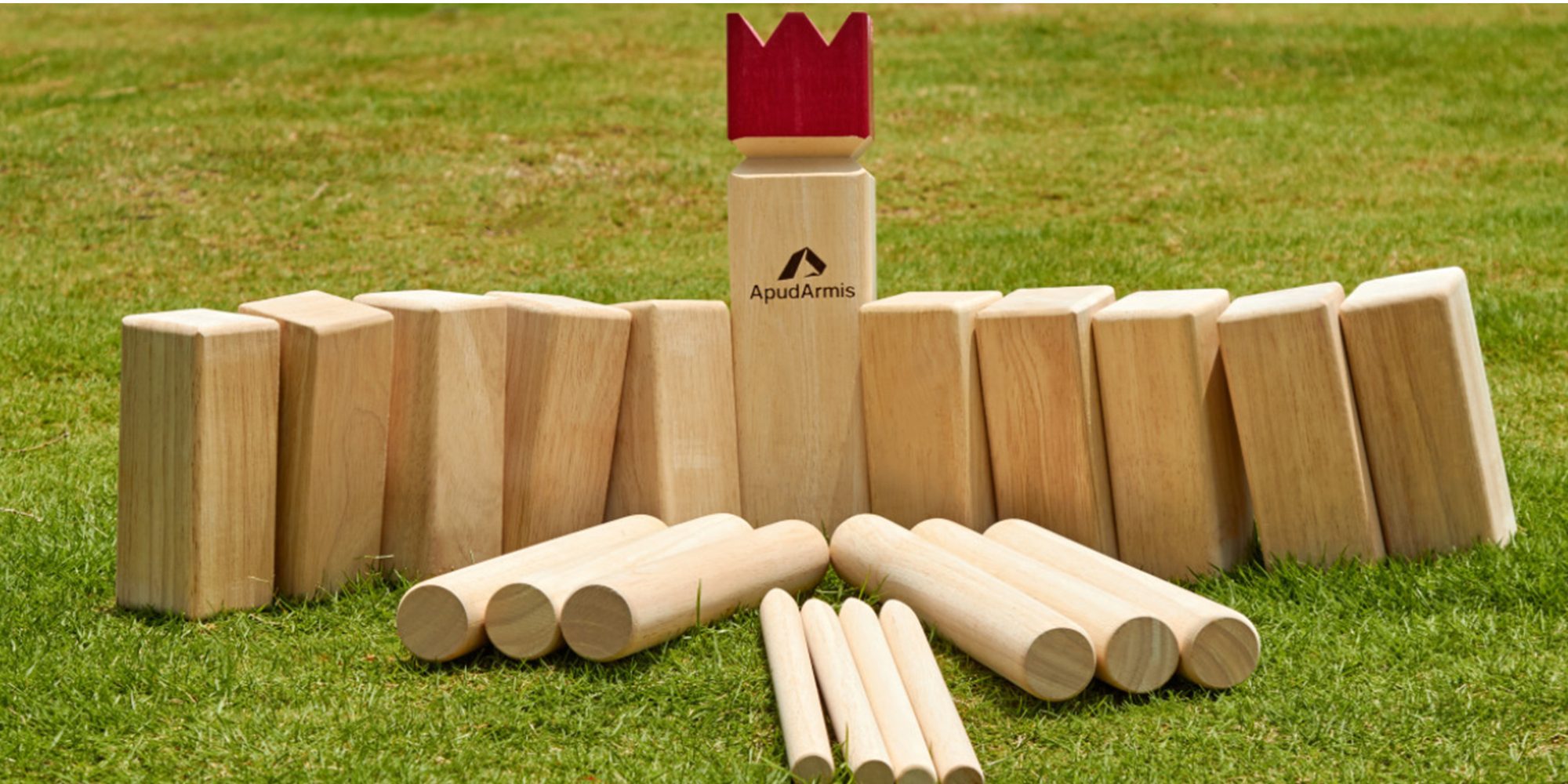
A tournament kubb field is 5 × 8 metres; for a family game in the backyard, 4 × 6 metres works. Push the four corner stakes in to mark the rectangle. The short sides are the baselines.
- Place five kubbs evenly along each baseline.
- Stand the king in the exact centre of the field.
- Each team stands behind its own baseline with the six batons.
Throwing the batons
Teams take turns throwing all six batons from their baseline at the other team's kubbs. Throws must be underhand, with the baton turning end over end — no sideways helicopter throws. A kubb counts as down when it falls flat.
Every kubb you knock over is thrown back by the other team into your half of the field, where it is stood up as a field kubb. Field kubbs must be knocked over before you can hit the baseline kubbs behind them.
Throwing the field kubbs back
The part of kubb that new players find strangest is also the part that decides most games. Every kubb you knock over is picked up by the other team and thrown back over the middle line into your half. Where it lands, it is stood up on end, and it becomes a field kubb: a target that must be knocked down before anything behind it counts.
If a thrown-back kubb lands outside the field, it can be thrown once more; if it misses again, the opponent places it wherever they like, as long as it is at least one baton length from the king and the corner stakes. That is why good teams throw field kubbs close together near the middle line, where a single heavy baton can take down two or three at once.
Once your field kubbs are standing, the team may throw at them from an advanced line: the line of the field kubb closest to the king. It is a small rule that gives weaker throwers a real chance, and it is one of the reasons kubb is such a good backyard game for people of all ages.
Going for the king
When a team has cleared every kubb from the other side, its next baton can go at the king, thrown from the baseline. Topple the king and the game is won.
Knock the king over by accident before then and you lose the game on the spot, which is why good players aim for the corners of the field and keep their throws low.
A short history of the Viking game
Kubb is often sold as Viking chess, and the story goes that Vikings played it with the bones of their enemies. What is certain is that the game was played for generations on Gotland, the largest island in Sweden, long before the first commercial sets came onto the market in the late 1980s. Sales took off quickly, and kubb began to spread around the Nordic countries and then across Europe.
Since 1995 the Kubb World Championship has been held on Gotland every summer, and national championships now run in Sweden, Germany, the Netherlands and many other countries. In the United States the game has grown especially fast in the Midwest, where clubs hold open tournaments in the park almost every weekend from spring to autumn.
Teams, kids and big groups
Kubb plays from one against one up to six against six; teams share the six batons each turn. For a family game in the garden, shrink the field to 4 × 6 metres and let younger players throw from a step or two in front of the baseline. Kids love the moment the king falls, and the game is short enough to hold their attention.
- Under-10s: shorter field, throw from in front of the line.
- Teens and adults: full 5 × 8 m regulation field.
- Big groups: up to six a side, sharing six batons per turn.
Kubb also makes a good outdoor game for a company picnic or a family reunion, because spectators can follow the score just by looking at which kubbs are still standing. Anyone can enjoy it, and the fun lasts long after the first game.
Tips and care
- Aim for one kubb at a time; a near miss on two is worth less than a hit on one.
- Throw field kubbs back close together, so the other team can knock several over with one baton.
- Keep the batons dry — a wet baton slips out of the hand on the throw.
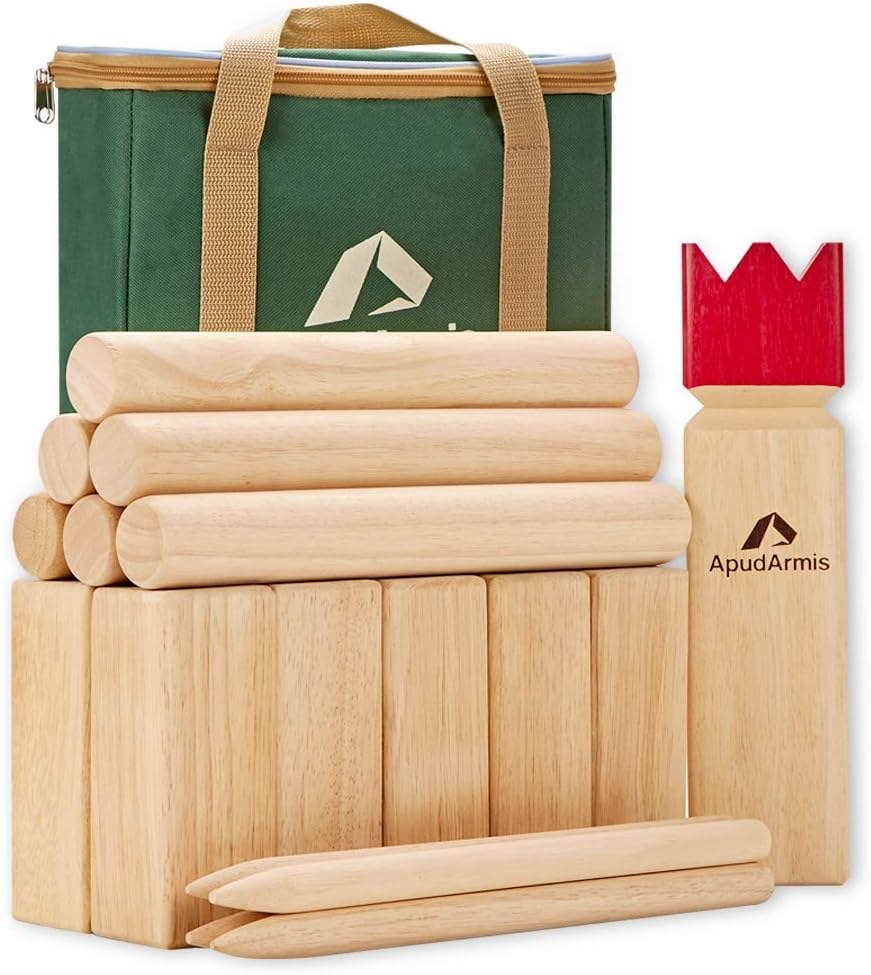
Rubberwood is durable, but like any solid wood it does not love standing water. Dry the pieces after an evening on damp grass, keep them in the carry case indoors over winter, and they will last for years. If you are looking for a kubb set to give as a gift, the ApudArmis set comes with a crowned king, ten kubbs, six batons, four stakes and a rule brochure, so the people who open it can play the same afternoon.